
Amelia and Me
My Search for the Real Amelia Earhart

This essay is part of a new series of B-Sider profiles about people who flip the record and listen to what’s calling to them.
The original B-Sider in my life is Amelia Earhart, my husband’s step-grandmother. Like the flip side of vinyl records, where musicians put their experiments, I think of B-Siders as the often-misunderstood outliers who think and act outside the mainstream. Often, their life choices look foolish to everyone else.
When I married into the Putnam family in 2005, I married into a trove of diaries, letters, photograph albums, and kitchen table memories. Listening to my husband and his sister, Sally Chapman, talk about Amelia and George started me on a multi-year hunt for the “real” Amelia, not the airbrushed heroine of popular accounts.
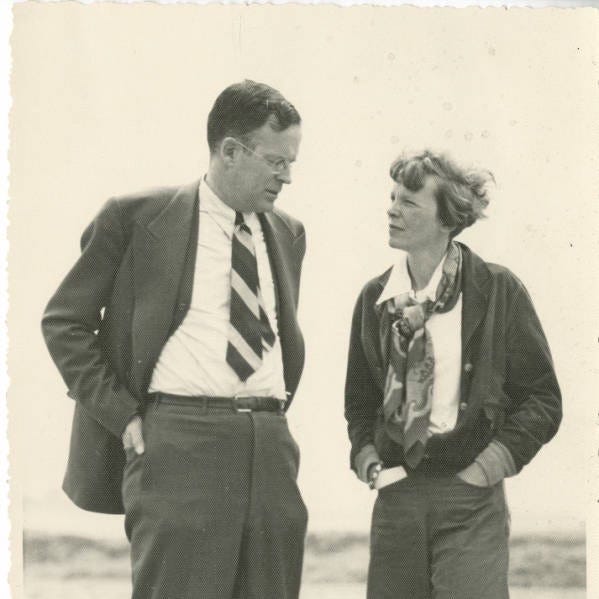
I admit I knew little about Amelia Earhart beyond the mythic storyline: brave pioneering pilot, feminist icon, and wife of publisher-promoter George Palmer Putnam. He was the guy in a suit and tie standing next to Amelia in press photos, looking stiff and grumpy. They struck me as an ill-matched couple, but I gave George no thought. Amelia stole my affections.
Digging through family archives and public sources, I soon realized how deeply I had underestimated them both. My fascination with their story bordered on obsession. Biographies and reference materials filled two bookcases. I became an erratic driver, pulling over to scribble notes on grocery-store receipts. At two in the morning, my husband David would come into the kitchen and find me hunched over my laptop, tracking down arcane details of aviation history.
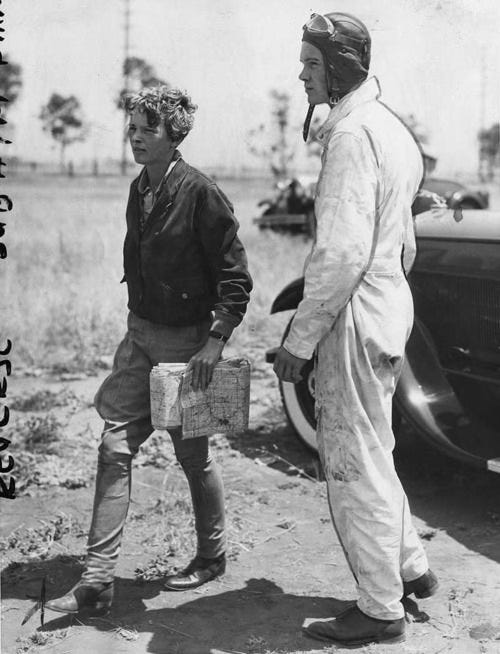
Like millions of Amelia’s fans, I admired her determination to stand out in the male-dominated world of aviation. It was the golden age of flying—glamorous and viciously competitive. Female pilots scrambled for the same shrinking pool of funding and press attention.
Amelia and her contemporaries flew at a hazardous time in early aviation. Of the first 40 pilots to fly U.S. mail—the top fliers from the war—31 died in crashes, earning the nickname “the suicide club.” While precise statistics are rare, contemporary accounts estimate that one out of every four pilots died attempting to set distance or transatlantic records.
Beyond Amelia’s bravery in the air, I admired her style. Her tousled hair that always looked great, even windblown. And no one wore pants like Amelia. When I found out she liked trousers because they were practical—climbing in and out of cockpits—and hid her shapeless ankles, I loved her even more. I felt a special connection. It helped that we were born on the same day—July 24—and both married strong-minded Putnam men.
There’s so much I’d like to share, but let’s start on February 7, 1931.
That morning, Amelia Earhart handed her future husband a handwritten note. She’d written it on his mother’s stationery, crossing out words as she refined her terms.
The famous letter read, in part: “I may not be able to endure at all times the confinements of even an attractive cage.”
She went on to spell out her conditions: she wouldn’t hold George (or herself) to a “medieval code of faithfulness.” Amelia wanted the freedom to work, to travel alone, to maintain her own income. And if the marriage didn’t work after a year, they’d call it quits.
Then, on those conditions, the couple married at the home of George’s mother in Noank, Connecticut. The couple went on the briefest of secret honeymoons. Then they got back to work.
The Problem with George
Beyond her undisputed bravery in the air, Amelia exhibited a different kind of courage, too. In an era when women’s choices came in three basic flavors—traditional dependent wife, sad spinster, or scandalous rebel—Amelia chose none of these.
She had her own view of how she wanted to live.
Which is why recent retellings of Amelia’s mythic life infuriate me. It’s true all myths need a protagonist and an antagonist, but biographers go too far when they reduce George to a cardboard villain, a toxic predator with no redeeming qualities.
A friend of Amelia’s and a fellow aviatrix, Elinor Smith, described George Palmer Putnam as handsome, wiry, and dynamic: “He was over six-feet tall with snapping dark eyes and close-cropped hair, and you could feel his electricity across a room.”
The electricity Elinor describes takes on a menacing, even malicious, character in a new biography by Laurie Gwen Shapiro. The author describes George as a “narcissistic con man” who pressured Amelia into dangerous flights for publicity. The New York Times review of Shapiro’s book amplifies the characterization, calling him “a horrible husband” and possible “killer” of Amelia.
I see a fatal flaw in the thesis: If George were as controlling, unscrupulous, and evil as these accounts claim, then Amelia—independent, intelligent, self-aware—was either complicit or foolish to stay with him.
I refuse to accept this diminished view.
Marrying a Putnam has given me access to family memories and archives that complicate the dastardly villain narrative. I can spot when biographers manipulate well-documented records to suit their narrative end. It depends on how they connect the dots—and which dots they conveniently omit.
Family history, Amelia’s own letters and writings, and contemporaneous accounts tell me Amelia made a deliberate choice to marry George. She appreciated his track record as publisher and promoter, understood what he could offer her, and negotiated a partnership that gave her access to influential people, funders, and press attention.
Hers wasn’t a trivial decision. The Depression had gutted the country. The mood of America was depressed. People were out of work, out of options, and aviation was an expensive gamble. Amelia faced fierce competition from more experienced aviatrixes fighting for the same sponsorships, headlines, and funding. I believe she married George not out of naivety or coercion, but because she saw how, together, they could keep her flying, make money, and live an adventurous life at a time when most people were just trying to survive.
She was a realist on a mission.
What Mythology Leaves Out
Before Amelia, George had been married to Dorothy Binney Putnam—heiress to the Crayola fortune and modern-day free spirit. They’d met on a John Muir climbing expedition. Dorothy gamely climbed to the summit in a skirt and walking shoes. George admired Dorothy. He understood she went after what she wanted.
Even during the Depression years, when most Americans were worn down and out of options, Dorothy kept her trunks filled with clothes for the next round-the-world trip. She left George behind and traveled. She had complete autonomy.
Amelia would have seen this dynamic up close. After Amelia became the first woman to cross the Atlantic by air, she lived at Dorothy and George’s house in Rye, New York. There, she wrote her first book with help from George and ghostwriters. Dorothy was still very much present in the household. Amelia witnessed firsthand the give-and-take of her relationship with George. So it doesn’t make sense that Amelia married him because he bullied her into it, though he did propose several times before she agreed. But by then, she recognized a man who could love a strong, independent woman.
That pattern mattered. Because when Amelia met George, she wasn’t arriving from a position of strength.
She’d spent three decades in obscurity, and often poverty. In 1928, the year she and George met, she was living at Denison House, a Boston settlement house where she taught English to Syrian children for minimal wages. She was in debt. On weekends, she threw pamphlets out of airplanes to support a local airfield. She was an inexperienced, unknown pilot in a crowded field of established aviatrixes.
What Amelia saw in George was someone who could make the doors and windows fly open for her. She became his willing student and, in short order, his equal partner in building what would become the Amelia Earhart franchise.
The Original Influencer
You can make the case that Amelia was more skilled as a role model than as a pilot.
That’s less a criticism than a recognition of where her talents lay.
Even her most devoted biographers admit she wasn’t flawless in the air. She daydreamed at the controls, landed on the wrong airstrips, and forgot to check fuel tanks. And she tended to do dumb stuff like forgetting to fill out her logbook because she’d rather be scribbling poems. Amelia wasn’t a “natural stick,” as aviators say. Many of her contemporaries exhibited equal daring and greater technical skill.
But we don’t remember them. We only remember Amelia.
Why? Because George understood something about fame that was decades ahead of its time. People don’t buy dry newspaper accounts. They crave human stories that give them hope for their own lives, stories that reflect their fears and dreams.
George pioneered what we now call personal branding. He was the undisputed master of making people famous through storytelling. He’d already made Lindbergh an international icon, shaping his lone crossing of the Atlantic into a mythic tale of courage and national identity. When George later met Amelia, he recognized even greater potential in her: courage combined with personal charisma.
Before Amelia’s first record-breaking Friendship flight in 1928, George and Amelia discussed every detail and nuance: what she’d wear (borrowed, ill-fitting flying togs), how she’d handle journalists (with humility and careful phrasing), what she’d say about the flight (she’d give full credit to the male pilots who flew the plane).
These weren’t accidents. They were part of a deliberate communications strategy designed to make her famous.
It worked spectacularly. One day she was an impoverished unknown. The next day, her face appeared on the front page of newspapers across three continents. Within months, she was dominating world headlines. She rivaled royalty and movie stars in global name recognition.
George’s promotional acumen extended beyond the risky cross-Atlantic flight itself. In London, George made sure the Putnam Publishing offices had a promotional machine waiting for her. George arranged for a New York Times correspondent to cover the story, accompanied by Hilton Railey, a prominent American PR expert. No other aviatrix had this support system.
When Amelia arrived in England, Lady Astor and other society figures provided her with gowns and fashionable clothes. George understood that if she arrived in unglamorous flying attire (if she arrived at all), the British elite would fill the gaps. He orchestrated their generosity, knowing it would win her acceptable in British society.
After the Friendship flight, coached in advance by George, Amelia kept reminding people she never once touched the controls. She told everyone she sat in the back like a “sack of potatoes.” Her alluring blend of humility and heroism attracted fans like moths to a bright light.
Amelia made flying seem as fun and effortless as driving a car. And more to the point, she didn’t make her daring exploits all about herself—her records, her beauty, her style. Instead, she gave her fans hope, showing them possibilities they’d never dreamed of.
That was the genius of Amelia: She made her story everyone’s story.
An Unlikely Partnership
George and Amelia were temperamental opposites. He was brusque, demanding, domineering. Prone to cussing. She was reserved, independent, and uncomfortable in crowds. An introvert with germophobic tendencies, Amelia couldn’t stand strangers touching her.
By conventional wisdom, their relationship should have ended in disaster.
Instead, they built what looks remarkably like a modern partnership. They kept autonomous finances; she regularly sent money to her sister, mother, and father. People assume George profited handsomely from Amelia’s books and promotional tours. Not true. As her agent, he took a standard agent’s share of ten percent; that was their agreed arrangement. He worked on Amelia’s behalf, like most things in his life, for the fun of it. By the time she departed on her final around-the-world flight, the two of them were nearly broke. The image of the calculating exploiter dissolves when you look at the ledger.
For months at a time, she and George traveled separately, though they kept in constant touch. George handled the business and promotional side. He booked lectures, negotiated with publishers, and managed the Amelia Earhart brand, including product endorsements, her own luggage line, even a fashion collection of minimalist clothing she designed. He constantly scrambled to find funding for her flights and secure bigger, better planes.
Amelia focused on flying and connecting with audiences. Coached by George, she understood that celebrity meant showing up, again and again, in every town and every kind of weather. She didn’t like it much; it was hard work traveling cross-country in her Chrysler roadster and by rail. But Amelia loved making money. For her, making money was almost as exhilarating as flying. Money gave her the freedom to live the life she wanted.
She and George understood what promoters know now but few knew then: grassroots human connections are key. With no television or internet, Amelia spoke in person at airfields, schools, and lecture halls. People wanted to hear her voice, touch her airplane, stand in her presence. It’s hard to overestimate the charisma she had back then, and George made sure her fame grew town by town, handshake by handshake.
But she wasn’t his puppet. The competition was fierce for headlines, sponsorships, and funding. Amelia had to keep breaking her own records to stay ahead. She had the strength to push back when she didn’t like George’s advice. Her prenup is proof of that.
The Flattening
History idealizes Amelia and demonizes George. But flattening George into a one-dimensional opportunist doesn’t make sense. It requires us to see Amelia as either complicit in her own exploitation or too naive to recognize it.
This portrayal respects neither her intelligence nor George’s many accomplishments—before, during, and after Amelia’s time. George served in Army intelligence, sat on the editorial board at Paramount Pictures, championed copyright protection for American authors, and invented the adventure-publishing genre. He counted among his friends John Muir, the naturalist; Admiral Byrd, the polar explorer; the pianist Ignace Paderewski, who became Poland’s Prime Minister; and top writers like Dorothy Parker.
Amelia, a close friend of Eleanor Roosevelt, and George were guests at the White House on more than one occasion. Thanks to George’s connections, the couple moved in the highest circles of American cultural and political life. George wasn’t some hanger-on or shallow opportunist. And he was at the forefront of aviation long before Amelia entered his orbit.
Amelia chose a flawed, complicated person who could help her achieve complicated goals. George may not have liked the sexual freedom clause in her prenup, but he agreed to carry on as her maestro of fame. When she wrote that she might not “endure the confinements of even an attractive cage,” she wasn’t being rhetorical or dramatic. She was being clear-eyed about what she needed.
And George understood that. Which is one of many reasons she married him.
Amelia’s Hidden Heroism
We’re still uneasy about recognizing women’s complex choices about partnerships. In popular culture, we often cast women as empowered individualists, traditional wives, or victims of male toxicity. The vast middle ground—where so many women live—remains largely hidden.
Amelia fought for her place in that middle ground nine decades ago. She wanted both marriage and freedom. She wanted partnership and autonomy. She refused to choose. And she made it work.
Not perfectly, of course. George was difficult, demanding, and brash. His many friends said he didn’t suffer fools, especially members of the press. They didn’t like him because he broke their rules. He often kept the press away from Amelia and inserted himself into photographs. He understood that a picture of Amelia alone was a media treasure, easy to reproduce and exploit. With him in the frame, the photo was less valuable. He wanted to control access to Amelia and manage her exposure.
It didn’t help that he looked so uptight in photos, which reinforced the view that he was difficult to like. People assumed he was grandstanding, trying to make himself famous. He cared less about their opinions than protecting Amelia, who detested the limelight and all the hullabaloo.
I can’t imagine how tough it must have been for her. She was the most famous woman in the world, yet crowds exhausted her.
George did his best to safeguard her autonomy and her privacy, while building the scaffolding for her career in aviation. That’s not a fairy tale. That’s a working partnership between two complicated people with the same goal.
For six years, until she disappeared into the Pacific Ocean, Amelia lived as she’d envisioned in that handwritten letter: free to work, free to be with other men, and free to fail.
Maybe the bravest thing she ever did wasn’t flying solo across the Atlantic or attempting to circumnavigate the globe.
It was demanding the right to build a life on her own terms—and finding the one partner who could join her in that adventure.
_______________________________
This essay is part of a new B-Sider series about people who refuse the “attractive cage” of conventional success. If you’d like to see another B-Sider story, watch my short film “Two Decades of Bula on the B-Side,” now streaming on YouTube.
Wow! What a fascinating story and it was so compelling to read. This truthful narrative should be out there for more people to know. It gives us insight into the “fame game” and how women can play it to their advantage without compromising their values. I think you need to write this book!
Thank you, Elisa! It feels cathartic to publish this after several years of researching and ruminating. Although there's no one truth about Amelia and George, I hope this essay sheds light on the nuances of their marriage and business relationship that can get buried in the mythology.