
Accidental Memoirist
How riding the wave of someone else's story exposed me

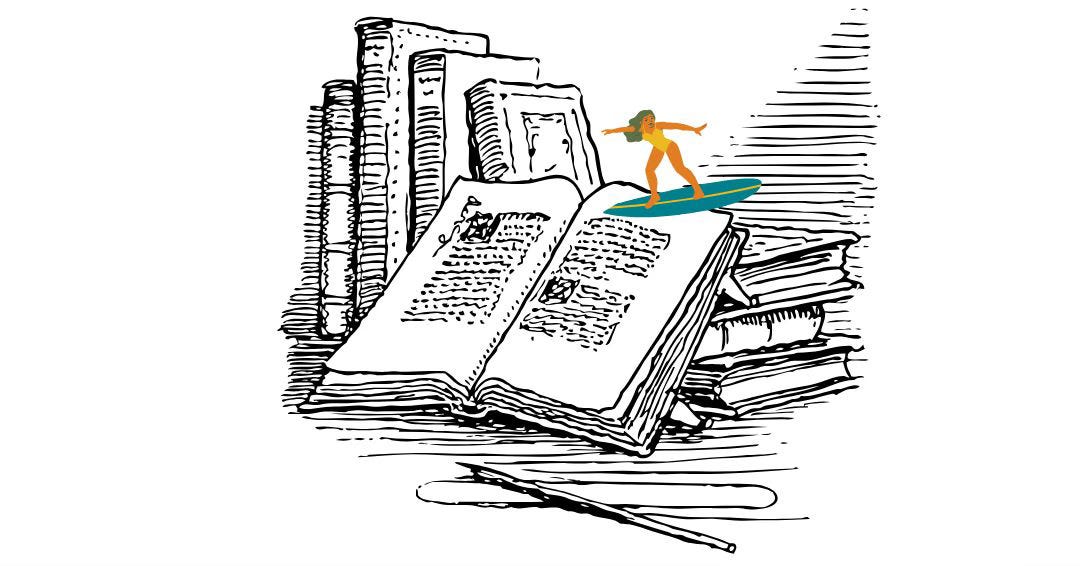
A few years ago, I set out to write a biography about a couple of genius surfer dudes living a dream life in the Caribbean. It was a curious choice that mystified both my friends and me, a recovering executive and non-surfer in Maine. Why was I drawn to the story of Bula, a little giant of a surf shop in Aruba? All I really knew was that I was 100 percent unfulfilled and desperate to write a book, something I’d attempted many times before. Like many writers in waiting, I’d struggled with imposter syndrome, perfectionism, and the growing suspicion that I was too old and tired to create anything of value.
I didn’t know it yet, but writing that book would expose me in ways I never could have imagined.
During a post-Covid reset under a mango tree in Aruba, I stumbled on the improbable story of Bula Surf Shop and its renegade cofounders who, two decades before, had risked everything to build a life of their own choosing. As a chronic overachiever and serial consumer of self-help books, my curiosity ignited.
David and Yair’s quest for freedom embodied everything that seemed lacking in my own life: courage, youthful risk-taking, the audacity to leap without a net. I fantasized about surfing the waves of their adventures. I could use the excitement of their unconventional path to write one hell of a good story—and never get my feet wet.
This was an old habit. As a former Manhattan book editor and corporate brand strategist, I’d spent my entire career helping others tell their stories while hiding my own.
So, when I started drafting the chapters, I edited myself out. Mostly. I made a fleeting entrance in the Preface, then disappeared, only to reappear in the Epilogue. I saw myself as the puppeteer, guiding readers toward the real heroes. Ironically, making myself invisible turned out to be the most revealing thing I could have done.
Every choice—whose voices to amplify, which scenes to leave in or out, what details mattered—was memoir in disguise. I was unwittingly smuggling my own sensibilities into every sentence. Even my obsessive rewrites—capturing the intoxicating scent of surf wax, for example—revealed something about me. Choosing their story over mine? That was the deeper story, though I had no clue at the time.
Modest to the core, David and Yair had only reluctantly agreed to interviews when I promised no “claiming”—surfer-speak for uncool boasting—and absolutely no PR. After the book came out, I secretly hoped they’d change their minds and agree to a little media. They didn’t, and by default, I became the reluctant spokesperson for my own work. Podcasters, reviewers, and book clubs wanted to hear not just about Bula’s cofounders, but also about me—how I found my mojo as a late-blooming author.
I hadn’t seen that coming. Sharing my journey, cautiously at first, opened up bigger questions: Why is it so difficult to claim our stories? Who decides which stories matter?
Writing Little Giant reminded me that not every great story becomes a bestseller or wins over the mainstream. Genre-benders like my hybrid memoir-biography defy easy categorization, making it difficult for booksellers and readers to discover them. I’d describe my book as an under-the-radar success, the kind you might expect when your curiosity seizes the wheel and you have no choice but to keep driving.
Often you don’t get to pick the story that chooses you.
The truth is, not every story deserves a place under the sun because a keyboard is at hand. There are self-serving tales masquerading as memoir. But there are also stories that grab you by the collar and demand to be told.
The worth of a story isn’t solely measured by critical acclaim, sales, or even the ability to inspire others. Sometimes you write simply to mute the noise in your own head or escape the self-imposed tyranny of literary standards. And sometimes you write because you don’t want to let anyone down, least of all yourself.
The Bula story was always mine—even as I cast David and Yair as the heroes—because it reflected the one truth I could own: I wrote the book because the story hooked me. Plus, I was running out of life span. When people ask what the book is about, I tell them it’s about two quiet nonconformists who—without intending to—sprung me free of my tiresome habit of discounting my abilities as a storyteller.
One of the most courageous things we can do is admit our story may not be capital-I Important. That doesn’t mean it isn’t worthy.
Sometimes a story shows up, and you’re brave enough—or just sick enough of your own excuses—to pay attention. Now, after decades of suppressing my voice in editorial and branding roles, I’ve finally stopped editing myself out of the frame.
Brevity, a literary journal, first published this essay as a guest blog on August 14, 2025. I adapted it slightly for Substack.
Thank you, Kathy, for your astute comments on the essay. It's fascinating that you, a highly accomplished artist, related to the creative struggles of those of us who wrestle words onto the page. I also appreciated your thoughts about following our curiosity, wherever it takes us.
Wow….what a powerful essay. You describe what so many creative people wrestle with. Perhaps the sheer joy of what your two protagonists were doing with their lives……surfing…..made contact with something deep inside you. The book reads like a story of your own curiosity….which is plenty of subject matter in my opinion! Watching the author go on a journey is one of the deep pleasures of reading